- What Does AI Implementation Actually Mean for a Small Business?
- Before AI: Is Your Business Ready?
- A Practical AI Implementation Roadmap for Small Business
- 1. Start with the business problem, not the AI tool
- 2. Map the process as it works today
- 3. Get the data and systems ready
- 4. Choose the right AI use case
- 5. Ask whether AI is actually necessary
- 6. Start small and define success
- 7. Build in security, governance, and human oversight
- 8. Test, train, and refine
- 9. Scale what works
- Where AI for Business Automation Can Go: From Simple Tasks to Custom Solutions
- What Small Businesses Should Skip
- Why AI Implementations Fail
- When an AI Implementation Partner Makes Sense
- Conclusion: Start With the Business, Then Build the AI
- READY TO PUT AI TO WORK IN YOUR BUSINESS?

For many business owners, experimenting with AI is no longer new. They’ve used it to draft content, summarize information, analyze data, support customer service, or save time on everyday tasks. As AI for small business becomes more commonplace, the bigger question is: where do you go from there?
A 2026 Goldman Sachs survey highlights the gap. Among 1,256 participants in its 10,000 Small Businesses program across the U.S., 76% said they were already using AI, and 93% of those users reported a positive impact on their business. Yet only 14% said AI was fully embedded in their core operations. Nearly three-quarters said they would benefit from additional training and resources to implement AI successfully and evaluate its impact.
That distinction matters. Using an AI tool for an isolated task isn't the same as full fledged AI implementation in business - making AI part of the systems, processes, and workflows that support everyday operations.
For many SME’s, the challenge isn't deciding whether AI has potential. It's figuring out where to start, which opportunities are worth pursuing, what needs to be in place first, and how to move from individual tools to AI that works within existing systems and processes.
That's where an AI implementation roadmap becomes useful. Rather than starting with the latest tool or agent, it starts with your business: the problems you need to solve, the processes behind them, the data and systems AI will rely on, and the outcomes you want to achieve.
What Does AI Implementation Actually Mean for a Small Business?
For a small & medium-sized business, moving beyond occasional AI use doesn't mean transforming everything at once. If you wonder how to implement AI in business, a practical approach begins with identifying where the technology can solve a meaningful problem and what it needs to do so reliably.
Think of implementation as a path. A business identifies an opportunity, examines the process behind it, determines whether its data and systems can support the solution, chooses an appropriate use case, tests it against a defined goal, and expands it when there is evidence that it works. This is AI implementation planning rather than simply adding another piece of software.
The foundation is especially important. AI tools and agents don't operate in a vacuum. They may need information from a CRM, ERP, spreadsheets, databases, customer records, or several connected applications. If that information is incomplete, difficult to access, inconsistent across systems, or out of date, the AI has a weak foundation to work from.
The same applies to business processes. An AI agent can be sophisticated, but it still needs to understand what should happen, what information it can use, when it should act, and when a person needs to become involved.
For AI for small and medium businesses to deliver value beyond isolated tasks, it therefore needs to become part of a functioning business environment. The roadmap isn't simply about choosing AI. It's about creating the conditions that make AI useful, dependable, and eventually scalable.
Before AI: Is Your Business Ready?
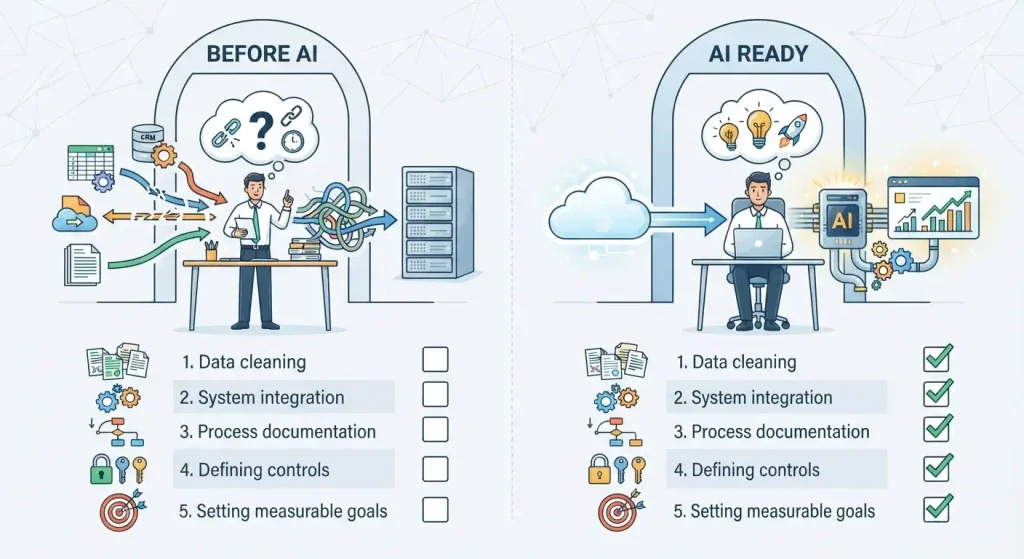
Before investing in a new tool or building an AI agent, closely examine the environment it will operate in. An AI readiness checklist should assess much more than whether your company has access to the latest technology. It should answer a practical question: Does AI have the information, infrastructure, and processes it needs to do useful work?
Start with your data. Where does it live? It may be spread across a CRM, ERP, spreadsheets, databases, shared drives, and other applications. Consider whether that information is accurate, current, consistently structured, and accessible to the systems that will need it. AI working from duplicate customer records, outdated pricing, or incomplete information can produce results that look convincing yet are still wrong.
Next, examine how your systems connect. If employees routinely copy information between applications, maintain separate spreadsheets because systems don't communicate, or rely on manual workarounds to complete routine processes, those gaps matter. Depending on the use case, integration work may need to be part of your small business AI implementation.
Process readiness matters just as much. Before asking AI to participate in a workflow, document how that workflow actually operates. Who initiates it? What decisions are made along the way? Which rules must always be followed? What are the exceptions? At what points does someone need to review or approve an action?
Then consider the people and controls around the technology. Determine who owns the process and its data, which information the AI is permitted to access, what security and privacy requirements apply, and who is responsible when something goes wrong. Employees also need to understand what the AI will do, what it won't do, and where their judgment remains necessary.
Finally, define what success looks like. An AI readiness checklist for business should connect every proposed implementation to a measurable outcome, whether that's reducing processing time, improving response times, decreasing manual data entry, increasing accuracy, or helping employees handle a larger workload.
Readiness doesn't mean everything must be perfect before you begin. It means knowing what foundation you're building on. Sometimes the first phase is cleaning data, improving CRM usage, integrating systems, or documenting a process. That work isn't a detour from AI implementation. It's what gives the technology a reliable foundation once it's put to work.
A Practical AI Implementation Roadmap for Small Business
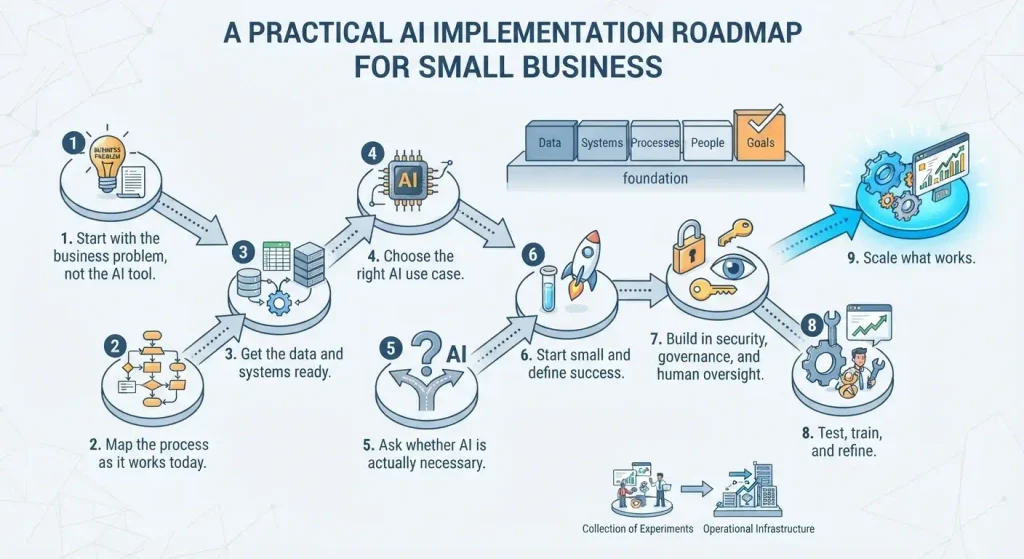
Once the foundation is in place, implementation becomes much easier. The goal isn't to introduce AI everywhere at once. A strong AI implementation roadmap small business owners can follow starts with one valuable opportunity and builds from there.
1. Start with the business problem, not the AI tool
Don't start with “How can we use AI?” Start with the problem you want to solve. Perhaps employees spend hours processing documents, customer inquiries aren't answered quickly enough, or valuable information is hard to retrieve. Defining the problem first makes it easier to determine which technology can actually improve it.
2. Map the process as it works today
Before changing a workflow, understand it from start to finish. Identify the people involved, the systems they use, the information flowing between them, decision points, exceptions, and manual steps. This often reveals inefficiencies that aren't obvious when looking at individual tasks.
3. Get the data and systems ready
Next, determine what information the solution will require and where it will come from. This might involve cleaning CRM records, standardizing data, connecting applications, or making information stored in spreadsheets more accessible. Effective AI for business automation depends on being able to access reliable information at the right point in a workflow.
4. Choose the right AI use case
Look for an opportunity where AI can address a defined problem and deliver a meaningful result. Good starting points often involve repetitive work that still requires some interpretation, such as extracting information from documents, classifying requests, summarizing customer histories, or helping employees find information across business systems.
5. Ask whether AI is actually necessary
Not every improvement requires artificial intelligence. Once the process is mapped, you may find that a straightforward workflow rule, system integration, CRM configuration, or conventional automation can address part or all of the problem. The objective is to improve the operation, not to introduce AI for its own sake.
6. Start small and define success
Instead of redesigning an entire operation, start with a focused use case that can be tested and measured. Define what success means before implementation begins. Depending on the problem, success could mean fewer manual steps, faster turnaround times, greater accuracy, lower operating costs, or more capacity for employees to focus on higher-value work.
This focused approach to implementing AI also makes it easier to identify problems before they affect a larger part of the business.
7. Build in security, governance, and human oversight
Decide what information the solution can access, what actions it is permitted to take, and which decisions require human approval. Sensitive customer, financial, or business data may require additional controls. Accountability must also be clear: someone should own the solution and be responsible for reviewing its performance.
8. Test, train, and refine
Real-world testing is essential because workflows rarely operate exactly as they appear on paper. Test routine scenarios, as well as exceptions and edge cases. Employees using the solution should understand its role, know how to recognize questionable results, and have a clear way to report problems.
Testing also provides an opportunity to refine instructions, integrations, decision logic, and workflows before expanding the solution.
9. Scale what works
A successful pilot provides evidence of what should happen next. Rather than adding unrelated tools, look for ways to extend proven capabilities across connected processes or departments.
This is where AI automation for small businesses can evolve from a collection of experiments into part of the company's operational infrastructure. Each successful implementation builds knowledge of the company's data, systems, workflows, and employees, making the next project more focused and effective.
Where AI for Business Automation Can Go: From Simple Tasks to Custom Solutions
Many companies begin with familiar applications such as summarizing CRM records, categorizing emails, extracting information from documents, assisting customer service teams, or creating meeting summaries. These are useful entry points for how to use AI for small business, but they represent only one level of what the technology can do.
More advanced implementations bring AI directly into the systems and workflows that run the business. It can interpret incoming information, help apply decision logic, trigger the appropriate next step, and support business flows that previously required more manual intervention.
The possibilities expand further when AI is combined with custom software development. Businesses can build mobile applications, client or partner portals, complex pricing tools, booking systems, data collection solutions, and complete operational platforms that align with how they actually work. AI-assisted coding can also accelerate development, helping experienced developers create these solutions more efficiently without sacrificing the architecture, testing, security, and maintainability required for long-term use.
This is where AI for SMB operations can move beyond adding standalone tools. AI agents, custom applications, CRM or ERP platforms, and other business systems can work together as part of a single connected environment.
For Customerization, these aren't separate disciplines. Its approach combines agentic AI, custom software development, and business application integration, allowing AI to become part of the technology a company already depends on rather than another disconnected layer.
The question then becomes much more useful than “What can AI do?” It becomes: “How can AI become part of the way my business actually operates?”
What Small Businesses Should Skip
A good roadmap isn't only about deciding what to implement. It also helps businesses avoid investments that create more complexity than value.
One of the biggest mistakes is buying an AI tool before defining the problem it needs to solve. The same applies to building an agent simply because agents are attracting attention. A new technology won't fix an unclear workflow, inconsistent data, or a process that already isn't working well.
Businesses should also be cautious about accumulating disconnected AI tools. If every department adopts separate applications without considering how they fit with existing systems, the result can be fragmented data, duplicated work, additional security concerns, and another collection of software employees have to manage.
Removing people from a process too quickly can create problems as well. Some workflows require judgment, approval, or accountability that shouldn't disappear simply because part of the process can be automated.
Ultimately, AI adoption small business initiatives shouldn't be measured by how many AI tools a company uses. If a simpler automation, better integration, or improved process solves the problem effectively, that's a successful technology decision too.
Why AI Implementations Fail
When an AI project doesn't deliver the expected results, the technology itself isn't always the problem. Many challenges in AI implementation stem from decisions made before the solution goes live.
Unclear objectives are a common starting point. If a business hasn't defined the problem, the desired outcome, or how success will be measured, it's difficult to know whether the implementation is working. Poor-quality data and disconnected systems can further limit what the technology can reliably accomplish.
Problems can also emerge after launch. Inadequate testing may leave unusual scenarios undiscovered, while weak employee adoption can result in a technically sound solution that people simply don't use. Security, privacy, ownership, and human oversight can become vulnerabilities if they aren't addressed early.
An AI implementation failure can also stem from unrealistic expectations. AI isn't a shortcut around sound processes, reliable data, or thoughtful system design. Successful implementation requires all of them working together.
When an AI Implementation Partner Makes Sense
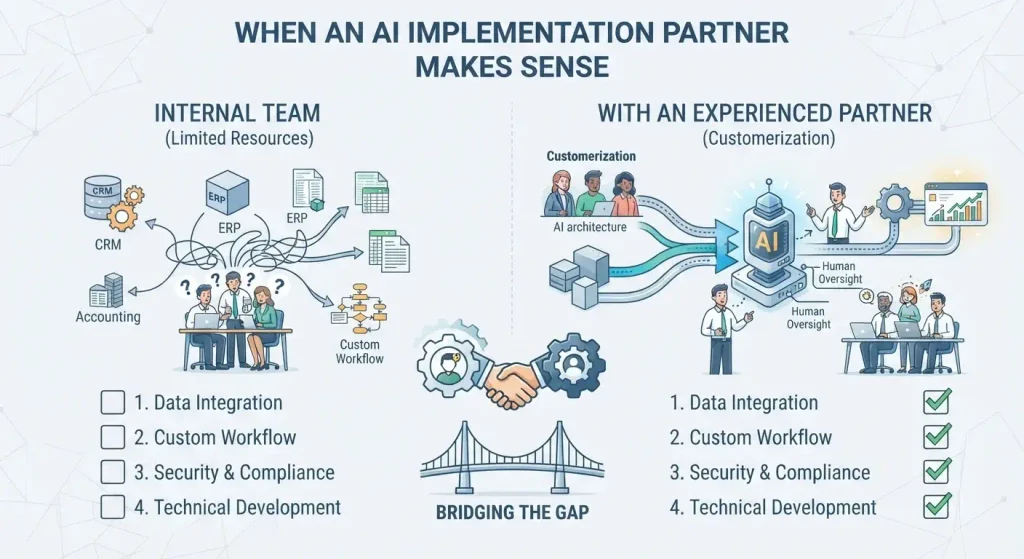
Some AI projects can be handled internally, especially when the use case is limited and the systems involved are straightforward. Outside expertise becomes more valuable when implementation spans multiple parts of the business.
For example, a project may require data from a CRM, ERP, accounting platform, or other applications to move through a custom workflow. It may involve integrations, data architecture, security requirements, decision logic, custom development, or processes where AI can take certain actions but employees must remain involved at critical points.
An experienced implementation partner can help determine how those pieces should work together before development begins. This is particularly useful during AI implementation for small business projects, where internal teams may understand their operations extremely well but lack the technical resources to design, integrate, test, and maintain the complete solution.
Customerization approaches these projects by first understanding the business problem, existing processes, and technology environment. From there, the team can determine where AI can add value and how it should connect with the systems already in place.
That may mean implementing an AI agent, integrating existing applications, developing a custom solution, improving the underlying technology foundation, or combining several approaches. The objective isn't to add AI wherever possible. It's to build a solution that works within the business and delivers a measurable result.
Conclusion: Start With the Business, Then Build the AI
Successful AI adoption isn't about implementing as much AI as possible. It's about identifying where the technology can solve a real problem and ensuring the business has the foundation to support it.
For SMBs, that means starting with clear objectives, reliable data, connected systems, well-understood processes, and measurable outcomes. From there, AI can evolve from a focused use case into a meaningful part of day-to-day operations.
A thoughtful approach to AI implementation in business also leaves room for the right solution to take different forms. Sometimes that's an AI agent. Sometimes it's an integration, a custom application, a workflow improvement, or a combination of technologies working together.
If you're considering AI but aren't sure where to start, Customerization can help assess your processes, systems, and readiness and develop a practical path from opportunity to implementation.
READY TO PUT AI TO WORK IN YOUR BUSINESS?
Share your processes, your tools, and your goals. We'll help you build a practical plan, from the first use case to AI that works with your existing systems.
Book a Free Call