Selecting an enterprise resource planning (ERP) platform is one of the most important technology decisions a growing business can make. The right solution can streamline operations, improve visibility across departments, and support long-term growth. However, the wrong one can lead to costly implementations, unnecessary complexity, and systems that fail to evolve alongside the business.
In our previous article, we introduced Zoho ERP and explored how it addresses a long-standing gap in the ERP market for growing organizations. Naturally, the next question many businesses ask is: How does Zoho ERP compare with one of its closest competitors, Odoo?
The answer isn't as simple as comparing feature lists. While both platforms offer comprehensive ERP capabilities, they are built on different philosophies and approach implementation, customization, and business growth differently. Choosing between them depends less on identifying the "better" product and more on understanding which solution best aligns with an organization's operational needs, existing technology investments, and long-term objectives.
This article provides an objective comparison of Odoo and Zoho ERP, highlighting their strengths, trade-offs, and ideal use cases. More importantly, it explores the broader considerations that influence a successful ERP project—from ecosystem strategy and scalability to implementation planning and future customization.
Before comparing functionality, however, it's important to understand how each platform approaches the ERP market and the types of businesses they were designed to support.
Understanding the Platforms: Odoo and Zoho ERP
Although both Odoo and Zoho ERP are designed to help businesses manage core operations from a single platform, they have evolved with different priorities and implementation philosophies.
Odoo began as an open-source business management platform and has grown into a comprehensive suite of integrated applications covering finance, sales, purchasing, inventory, manufacturing, human resources, and more. Its modular architecture allows organizations to implement only the applications they need and provides significant flexibility for businesses with highly specific operational requirements.
Zoho ERP, by contrast, builds on Zoho's established portfolio of business applications. Rather than developing a standalone ERP platform from the outset, Zoho first introduced solutions such as Zoho Books, Inventory, Billing, Payroll, and CRM, then brought key financial and operational capabilities together into a unified ERP experience. This enables organizations already invested in the Zoho ecosystem to adopt enterprise resource planning while continuing to leverage applications such as Zoho CRM, Analytics, Projects, Creator, and People.
Although both platforms aim to improve operational efficiency, they also differ in the broader ecosystems that support them. Beyond core ERP functionality, businesses should consider available integrations, implementation partners, customization options, and long-term platform evolution when evaluating each solution.
A closer look at each platform's core capabilities helps illustrate those differences.
Feature Comparison of Both Platforms
Both Zoho ERP and Odoo provide the core capabilities expected of a modern ERP solution, including financial management, procurement, inventory, manufacturing, sales, reporting, and workflow automation. However, their feature sets reflect distinct product strategies and priorities.
According to Zoho's official ERP documentation, the platform emphasizes connected operations by integrating finance, purchasing, warehouse management, manufacturing, payroll, quality management, reporting, and document management within a unified business environment. This integrated approach is designed to provide end-to-end visibility across the organization.
Odoo similarly offers a broad suite of business applications through its modular ERP platform, covering accounting, CRM, inventory, manufacturing, purchasing, project management, marketing, and human resources. Businesses can implement only the applications they require and expand the platform as operational needs evolve.
Rather than comparing the number of available modules, businesses should evaluate how each platform delivers these capabilities, the level of configuration and customization required, and how well the solution aligns with their operational processes. Reviewing each vendor's official feature documentation is a useful starting point, but the real evaluation begins with understanding how those capabilities align with a business's operational requirements and long-term goals.
Ecosystem Comparison of Odoo and Zoho ERP
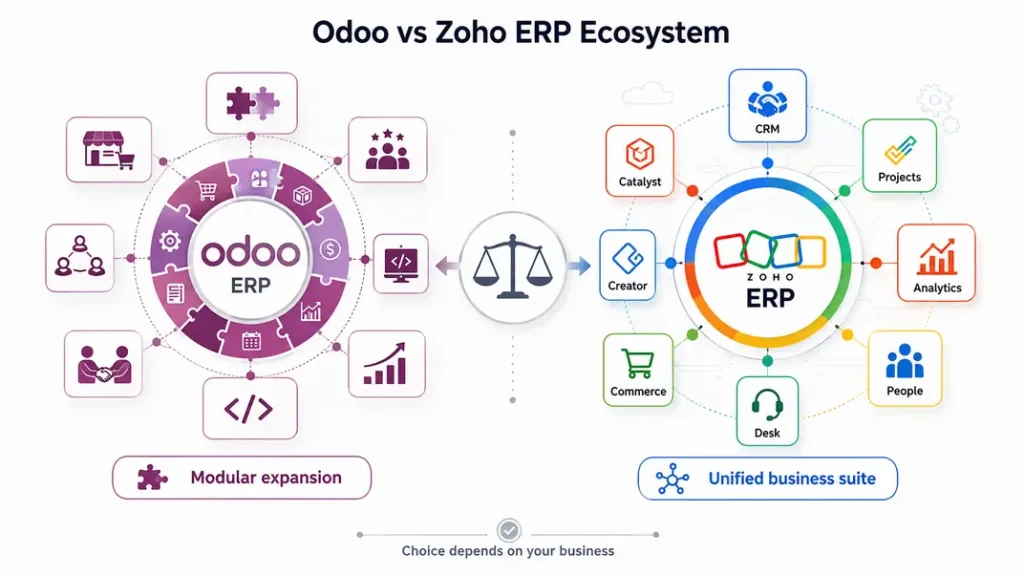
An ERP platform does not operate in isolation. As businesses grow, they often need additional applications, third-party integrations, custom development, and implementation expertise to support evolving operational needs. Evaluating the surrounding ecosystem is therefore as important as comparing ERP functionality.
One of Zoho ERP's unique strengths is its integration with the broader Zoho platform. While the ERP delivers comprehensive operational capabilities on its own, organizations can also integrate it with complementary business applications such as Zoho CRM, Projects, Analytics, People, Desk, Commerce, Creator, and Catalyst. This enables businesses to extend functionality, automate processes across departments, and develop custom solutions while staying within a unified technology environment.
Odoo similarly offers an extensive ecosystem built around its modular architecture. Businesses can expand the platform by adding applications as operational requirements evolve, while also benefiting from Odoo's global partner network, marketplace, and active developer community for implementation, customization, and ongoing enhancements.
Neither ecosystem is inherently better—they simply reflect different approaches. Organizations already invested in Zoho may value the breadth of its business application portfolio and low-code development capabilities, while others may prefer Odoo's modular expansion model and extensive marketplace. Ultimately, the right choice depends on the organization's existing technology landscape, growth strategy, and long-term operational goals.
Which Businesses Are the Best Fit?
There is no universal "best" ERP platform. The right choice depends on an organization's operational complexity, existing technology investments, growth strategy, and long-term business objectives.
Organizations already using Zoho applications may find Zoho ERP a natural progression. Businesses that rely on solutions such as Zoho CRM, Books, Analytics, or Projects can expand into ERP while continuing to work within a connected business platform, reducing the need to introduce additional vendors as operational requirements grow.
According to Odoo, its platform is used across a wide range of industries, including manufacturing, wholesale distribution, retail, construction, and professional services. Its modular architecture enables organizations to implement the applications they need and expand functionality as business requirements evolve.
Rather than selecting an ERP based solely on industry or feature comparisons, businesses should assess how each platform aligns with their existing systems, operational processes, and future growth plans. The most successful ERP projects begin with a clear understanding of business requirements before software selection.
Implementation Considerations
Selecting an ERP platform is only the beginning. A successful implementation starts with understanding how the business operates today, where inefficiencies exist, and what the organization hopes to achieve in the future. Before any software is configured, businesses should define their operational requirements, map key workflows, and identify the stakeholders who will use the system daily.
When evaluating ERP solutions, it's important to consider the total cost of ownership, not just software licensing. While licensing is often the most visible expense, a successful ERP project typically includes several additional components, such as:
- Software licensing
- Business process discovery and requirements analysis
- Solution design and implementation planning
- Configuration and customization
- Data migration
- Integration with existing systems
- User training and change management
- Testing and go-live support
- Ongoing maintenance, support, and future enhancements
Considering these costs early in the planning process helps businesses develop more realistic budgets, set clear expectations, and avoid unexpected expenses later in the project.
Another important issue to keep in mind is striking the right balance between configuration and customization. Wherever possible, businesses should use native functionality and configuration before introducing custom development, reserving customization for requirements that deliver genuine operational value. This approach often reduces implementation complexity and makes future upgrades and ongoing maintenance more manageable.
An experienced implementation partner plays a critical role throughout this process. Beyond configuring the software, the right partner helps organizations evaluate business requirements, recommend the appropriate solution architecture, manage the implementation project, support user adoption, and identify opportunities for future optimization.
For businesses requiring functionality beyond standard ERP capabilities, platforms such as Zoho also provide technologies like Zoho Creator and Catalyst, enabling custom applications and extensions to be developed while remaining within the broader Zoho platform.
Ultimately, a successful ERP implementation is not simply about deploying new software—it's about building a business platform that can adapt and grow alongside the organization. The right planning, implementation strategy, and long-term partnership can have a greater impact on project success than the software itself.
Making the Right Choice

Both Odoo and Zoho ERP offer robust capabilities for growing businesses, but they approach enterprise resource planning from different perspectives. Rather than searching for a universally "better" solution, organizations should evaluate which platform best aligns with their operational processes, existing technology investments, customization needs, and long-term business strategy.
Equally important is recognizing that ERP success depends on far more than software selection alone. A thoughtful implementation strategy, realistic planning, user adoption, and the right balance between configuration and customization all play a critical role in delivering long-term business value. As organizations grow, the ability to extend and adapt their ERP environment—whether through native capabilities or custom development—becomes as important as the platform itself.
At Customerization, we help businesses navigate every stage of the ERP evaluation and implementation journey. From assessing operational requirements and selecting the right platform to implementation, customization, and future enhancements, our goal is to deliver solutions that support sustainable growth long after go-live.
Ready to take the next step? Contact Customerization to assess your ERP requirements and determine whether Odoo or Zoho ERP is the right fit for your business.
Still Deciding Between Odoo and Zoho ERP?
Not sure which platform makes more sense for your business? Let’s talk through your needs, current systems, and what you’re planning for the future.
Book a free 30-minute consultation with a Customerization ERP specialist — no pressure, just a conversation to help you make the right choice.
Book a Free Call