- What Is ERP and CRM?
- ERP Software: The Backbone of Business
- CRM: Understanding the Customer is Key
- The Rise of Agentic AI in ERP and CRM
- ERP vs CRM: What are the similarities?
- Data management and analysis
- Integration with other software systems
- User interface and user experience
- ERP vs CRM: Where Do They Differ?
- Primary Function
- Data Sources and Management
- Users and Accessibility
- Integration
- Who needs ERP software?
- Who needs CRM software?
- Who needs both CRM and ERP software?
- The Winning Combo: SMP's Sales Triumph with Zoho CRM and Oracle ERP Integration
- Over to you

As businesses grow and evolve, organizing and managing their daily operations becomes increasingly complex. ERP and CRM are the two core systems that are aimed to solve these operational problems. However, CRM and ERP are not the same thing.
While ERP systems manage core business functions such as finance, inventory, procurement, production, warehousing, and order fulfillment, CRM systems focus on managing sales pipelines, customer interactions and satisfaction. In this blog, we'll be taking a closer look at ERP and Customer Relationship Management systems, clearing up the confusion that often surrounds them. We'll explain the differences between ERP and CRM systems, how artificial intelligence is reshaping both categories, and how they can help businesses manage their operations and thrive.
What Is ERP and CRM?

ERP Software: The Backbone of Business
ERP software is an integrated suite of applications designed to automate and streamline essential business functions such as finance, accounting, inventory management, procurement, and human resources. By consolidating these functions into a single, unified system, ERP software enables businesses to optimize their operations, improve productivity, and reduce inefficiencies.
Up to 95% of companies experience process improvement after implementing an ERP system. That demand hasn't slowed down, the global cloud ERP market is projected to reach roughly $76.17 billion in 2026, on its way to over $207 billion by 2034, growing at a 13.4% CAGR. Deployment preferences are shifting too: cloud models held just over half the ERP market in 2025, but hybrid configurations — blending private, public, and on-premises infrastructure — are now the fastest-growing segment, expanding at roughly 15–16% CAGR as multinational companies keep sensitive financial data on local servers while running analytics in the cloud. Moreover, advanced analytics capabilities often come with ERP systems to provide valuable insights into business performance, empowering data-driven decisions that drive growth and success.
CRM: Understanding the Customer is Key
While ERP software consolidates essential business functions to optimize internal operations, CRM software is a tool designed to help businesses manage and improve their customer relationships. Forrester-Freshworks research shows that 4 out of 10 firms boost revenues by 11-20% with a CRM implementation. In fact, 89% of companies see a revenue bump after implementing a CRM.
One of the defining characteristics of customer relationship management is its ability to streamline sales, marketing, and customer service operations. By consolidating customer data and automating tasks related to customer engagement, CRM software enables businesses to track customer interactions, analyze customer behavior, and personalize customer communications.
The Rise of Agentic AI in ERP and CRM
Here's the shift happening right now, generative AI was always something you had to ask for help. Type a prompt, get a draft, move on. Agentic AI works differently. It doesn't wait around for the next prompt, give it a goal and it'll plan the steps, pull in the tools it needs, and just do the work. Reconcile that invoice exception. Notice a shipment has stalled and reroute it. Follow a sales lead all the way from “hello” to “signed.” No one's babysitting it through each step.
So how real is this, actually? Gartner put some numbers on it in 2026, and they're worth sitting with. Only 17% of companies have actually deployed AI agents so far. But over 60% say they plan to within two years, which Gartner flags as the steepest adoption curve of any new technology they're currently tracking. Read between those two numbers and you get the real story: almost nobody's there yet, but almost everybody's heading there. That gap is exactly why ERP and CRM vendors are scrambling right now.
And you can already see it in what they're shipping. Oracle NetSuite leaned hard into this at SuiteWorld 2025, launching SuiteAgents, AI “workers” that run multi-step ERP processes on their own, plus an Autonomous Close feature built to turn a days-long month-end close into something closer to hours . Microsoft and SAP aren't far behind, building similar agents into anomaly detection, cash-flow forecasting, and compliance work. On the CRM side it looks a little different but the idea's the same, AI for CRM is moving past “here's a suggested reply” into “I already resolved the ticket” or “I already qualified the lead.”
This is where ai for erp operations stops sounding like a sales pitch and starts looking like something you'd actually put in a budget line. Nobody's asking “does it have a chatbot” anymore. The real question is whether it can quietly handle multi-step work across finance, supply chain, and customer service, without someone nudging it along the whole way.
But that 17%-vs-60% gap cuts both ways. It's exciting, sure, but it's also a quiet warning. An agent that's allowed to act on its own needs clean data underneath it, the same data mess ERP and CRM integration was already trying to fix, plus someone deciding, clearly, what it's actually allowed to do. Skip that part and you don't get a useful agent. You get one that either does nothing, or confidently does the wrong thing. That's exactly why companies needing AI integration for ERP or CRM are bringing in outside help before they flip the switch, getting the foundation right matters more than getting there first.
If there's one practical takeaway here, it's this: AI agents built into your ERP or CRM are becoming table stakes, not a luxury add-on. And the businesses pulling ahead aren't the ones moving the fastest, they're the ones with clean data and one clear use case to start with. That's usually the difference between an agent that earns its keep and one that turns into an expensive science experiment nobody uses.
ERP vs CRM: What are the similarities?
Before we dive into the differences, it’s important that we get similarities out of the way. Understanding the similarities can help business owners choose the right system(s) for their needs and optimize their operations.
Data management and analysis
- Both ERP and CRM systems involve the management and analysis of business data to improve decision-making and optimize operations.
- While ERP systems primarily focus on managing and integrating data across various departments and functions, CRM systems focus on managing and analyzing customer data to improve customer interactions and satisfaction.
- Both systems provide advanced analytics capabilities that allow businesses to generate insights from their data and make data-driven decisions.
Integration with other software systems
- ERP and CRM systems can be integrated with other software applications to create a more efficient and effective business infrastructure.
- While ERP integration typically focuses on optimizing internal operations and creating a unified view of the entire business process, CRM integration is more focused on improving the customer experience and streamlining sales and marketing processes.
- Integration with other software systems can help businesses achieve greater efficiency, accuracy, and productivity, as well as enhance their reporting and analysis capabilities.
User interface and user experience
- Both ERP and CRM systems strive to provide users with a seamless and intuitive interface that is easy to use and navigate.
- While ERP systems tend to have a more complex interface due to the broad range of functions they manage, CRM systems typically have a simpler and more streamlined interface that focuses on customer interactions and sales processes.
- Both systems strive to provide a positive user experience that meets the needs of their respective users.
ERP vs CRM: Where Do They Differ?

Primary Function
While both CRM and ERP systems are designed to help businesses manage their operations, they serve different primary functions. For comparison ERP software focuses on managing the back-end operations of a business, such as finance, accounting, and inventory management, while CRM software focuses on managing customer interactions and relationships.
Data Sources and Management
The difference between CRM and ERP systems when it comes to data, is that ERP software typically tracks data from internal sources, such as financial data and inventory levels, while CRM software tracks data from both internal and external sources, such as customer interactions on social media and website activity.
Furthermore, ERP software typically manages a broad range of data across multiple departments, while CRM software focuses specifically on customer data. ERP software is designed to provide a holistic view of a business's operations, while CRM software provides a comprehensive view of customer interactions.
Users and Accessibility
ERP software is typically used by employees across multiple departments, such as finance, accounting, and human resources, while CRM software is primarily used by sales, marketing, and customer service teams. ERP software requires specialized training, while CRM software is typically easier to use.
Integration
When it comes to business operations, CRM and ERP integration plays a crucial role in streamlining processes and improving customer interactions. The integration of ERP and CRM systems with other software applications highlights a clear distinction between their respective purposes. ERP systems, designed to streamline business processes across various departments, focus on optimizing internal operations when integrated with other applications. This connectivity fosters increased efficiency, more accurate data sharing, and improved decision-making across the organization.
Conversely, CRM systems are dedicated to enhancing customer relationships by improving interactions and personalizing experiences. The integration of CRM systems with other applications aims to streamline sales and marketing efforts, provide valuable insights on customer behavior, and promote targeted engagement strategies. By incorporating CRM and ERP integration into their operations, businesses can achieve a more comprehensive view of their organization and customers, ultimately leading to improved performance, enhanced customer satisfaction, and sustained growth.
Who needs ERP software?

- Small and mid-sized manufacturers with complex operations that require management of multiple departments and functions, such as finance, accounting, procurement, inventory management, and human resources.
- Businesses that need to integrate and streamline their data management across multiple departments.
- Businesses that want to optimize their supply chain management, procurement, and inventory management processes.
- Businesses that need advanced analytics capabilities to make data-driven decisions about their operations.
For example, a growing manufacturer with multiple production lines may need ERP software to manage inventory, procurement, production scheduling, and order fulfillment from a single platform. Likewise, a wholesale distributor handling hundreds or thousands of SKUs can use ERP to streamline purchasing, warehouse operations, and inventory control while improving visibility across the business. ERP gives smaller businesses the processes and visibility typically associated with much larger organizations, making it easier to scale without adding unnecessary complexity.
While ERP software offers comprehensive business management capabilities, not every business needs every module from day one. Many small and mid-sized companies start with the functions that solve their biggest operational challenges and expand the system as the business grows.
Who needs CRM software?
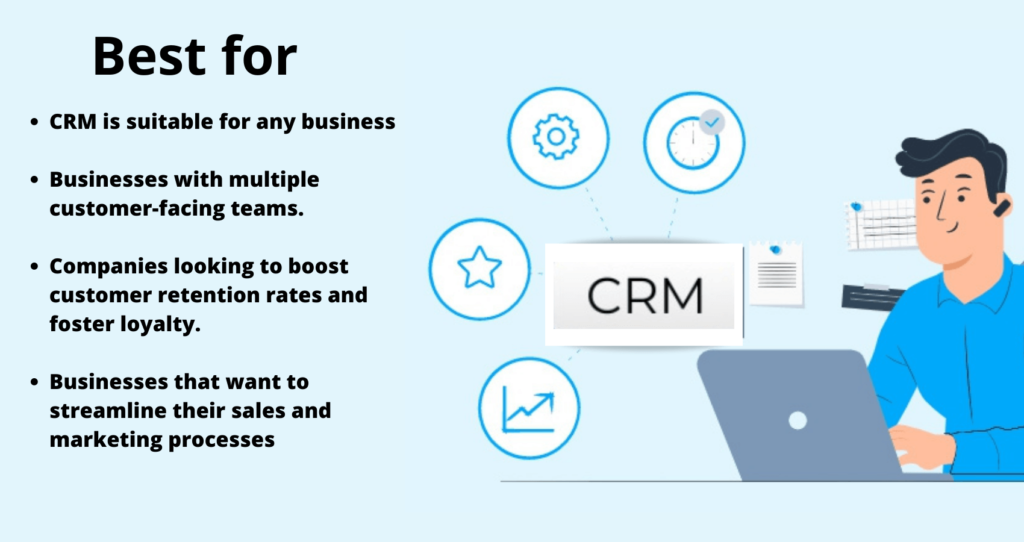
In today's competitive business environment, virtually any business can benefit from CRM software. As businesses grow and expand their customer base, managing interactions and maintaining strong relationships becomes essential for success.
Businesses with multiple customer-facing teams, such as sales, marketing, and customer service departments, require efficient collaboration and a unified view of customer data to optimize their interactions and deliver a seamless experience.
Organizations that are data-driven and aim to leverage customer insights for informed decision-making can use CRM software to track and analyze customer data, enabling them to fine-tune their sales and marketing strategies.
Companies looking to boost customer retention rates and foster loyalty can benefit from CRM systems, which allow them to tailor personalized experiences and track customer preferences, leading to higher satisfaction and long-term relationships.
CRM software is also essential for businesses that want to streamline their sales and marketing processes by automating tasks, improving lead management, and integrating with other tools to create a cohesive and efficient system.
By adopting CRM software, organizations can stay ahead of the curve, ensuring they maintain a strong customer focus while improving internal collaboration and leveraging valuable insights for growth.
For instance, e-commerce businesses that want to provide personalized product recommendations and promotions to their customers may need CRM software to track customer behavior and preferences. Similarly, financial services companies that want to provide tailored investment advice and portfolio management to their clients may need CRM software to track client profiles and transactions.
While CRM software is essential for businesses that want to improve customer interactions and satisfaction, it may not be necessary for businesses that do not interact directly with customers. For instance, B2B businesses may not need CRM software as their sales cycles are often longer and require a different approach.
Who needs both CRM and ERP software?
Mid-sized and large businesses that require both comprehensive data management across multiple departments and a focus on improving customer interactions and satisfaction can benefit from CRM integration with ERP
- Businesses that need to integrate and streamline their sales, marketing, and customer service processes with their internal operations.
- Businesses that want to optimize their operations and improve their customer engagement and retention rates will also benefit from integrating ERP with CRM.
- Businesses that want a single, clean data layer so AI agents can act across both customer-facing and back-office workflows without manual handoffs.
For example, a manufacturer producing custom components for multiple customers may need both ERP and CRM software to manage production schedules, inventory, procurement, and customer orders. Similarly, a wholesale distributor supplying products to dealers or commercial buyers may need both ERP and CRM software to manage inventory, purchasing, pricing, sales pipelines, and customer relationships from a single connected system.
The Winning Combo: SMP's Sales Triumph with Zoho CRM and Oracle ERP Integration
SMP - Specialty Metal Products, a family-owned custom metal cutting and distribution business, faced a significant challenge due to the limitations of their ERP system, SM3 (Steel Manager III). While SM3 helped streamline their business processes, it was not a customer-centric system and could not provide insights into customer-level analysis, which hindered their growth. To address this issue, SMP realized they needed to adopt a CRM system, ultimately choosing Zoho One for its customization flexibility, commercial effectiveness, and mass marketing functionality. However, integrating their Oracle ERP database with Zoho CRM posed concerns regarding effort, time, and cost.
To overcome this challenge, SMP enlisted the help of Customerization , a digital transformation consultancy and provides CRM consulting services specializing in Zoho solutions and other CRMs. Customerization suggested using Zoho Analytics, an advanced Business Intelligence tool, to synchronize customer, sales, and product information from Oracle to Analytics. This "light" integration enabled SMP to avoid costly and time-consuming point-to-point API integration between the two systems.
Furthermore, Customerization embedded Analytics dashboards and reports directly into Zoho CRM and set up a customer marketing capability using Zoho's marketing suite (Campaigns). This unified system allowed SMP's sales team to access accurate customer data, enabling them to manage customer relationships profitably and drive more revenue, all within two months and at a fraction of the cost of an Oracle ERP extension and development. Read the full case study.
Over to you
When it comes to choosing between ERP and CRM software, businesses need to carefully evaluate their needs and budget. If your primary goal is to optimize your business operations, then ERP may be the better choice for you. However, if you're looking to enhance your customer experience and build lasting relationships with your clients, then CRM may be the way to go.
Increasingly, though, the real question isn't ERP or CRM — it's how well either ERP/CRM system can be extended with AI agents that act on clean, unified data. If you're evaluating AI ERP options, weigh data readiness and governance as heavily as the feature list — that's usually what decides whether an AI agent earns its keep or quietly gets switched off a year later.
Ultimately, the right choice will depend on your unique business needs and goals. It's important to thoroughly evaluate both options and choose a system that will help drive growth, efficiency, and success for your organization.
The implementation of CRM/ERP systems is a crucial process that requires meticulous planning down to the smallest details. That's why organizations often seek the services of external consultants who can assist not only in strategy formation but also in its execution. They can identify potential challenges, suggest best practices, and ensure a smooth transition throughout the implementation process.